
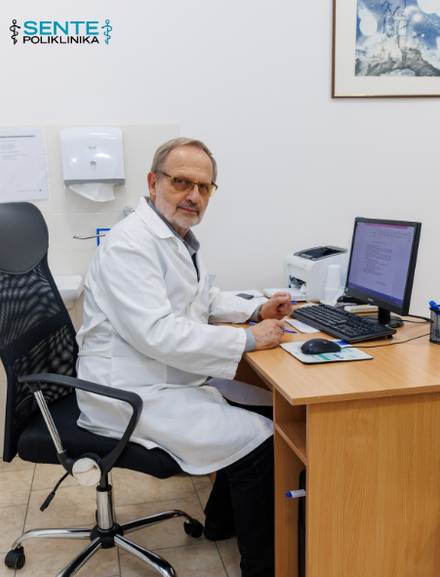
dr med Duško Špirta
Neuropsychiatrist
Neurological and psychiatric examinations, EEG, colour Doppler of the neck and head vessels, nerve blocks and infusion therapy.
Prices and available appointments: 024 520 698 and 066 52 32 899
A neurologist deals with diseases of the brain, spinal cord and peripheral nerves: headaches, dizziness, epilepsy, the after-effects of stroke, back pain spreading into an arm or leg, numbness and weakness.
A neuropsychiatrist also deals with mental health problems, such as anxiety, depression and sleep disorders.
At Poliklinika Sente the neurological examination is complemented by EEG and colour Doppler of the neck and head vessels, and nerve blocks and infusion therapy are used for painful conditions of the spine and nerves.
Psychiatric examination and treatment are provided by neuropsychiatrists, and a developmental neuropsychiatrist is available for children.
When you book, say which doctor you would like to see. If there is no free appointment with that doctor, reception will offer you the nearest available slot.
Neuropsychiatrist

Neurologist
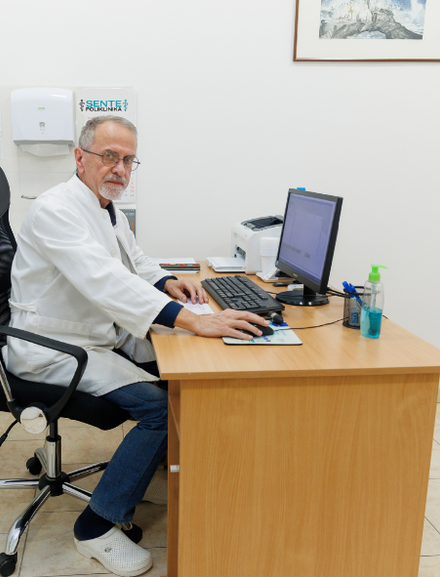
Neuropsychiatrist
Paediatrician, developmental neuropsychiatrist and clinical geneticist
Examinations carried out at Poliklinika Sente, with a description of what they involve and how to prepare.
An EEG is a recording of the brain's electrical activity, taken through electrodes placed on the scalp. The test is painless, involves no radiation and takes up to 30 minutes.
What it involves and how to prepare →Colour Doppler is an ultrasound examination that shows the wall of a blood vessel and the flow of blood through it. It detects narrowing, widening and blood clots in the arteries and veins of the neck, head, arms and legs.
What it involves and how to prepare →The articles in this section serve to educate and inform visitors to this website. They are not medical advice and cannot replace an examination by a doctor.
The same symptom has different causes. Which fingers are numb and when the trouble appears often says more than how strong the numbness is.
Numbness, burning and weakness in the hand are usually not a problem of the hand itself. The nerve that runs to the fingers sets off from the cervical spine and passes through the shoulder, the elbow and the wrist, and it can be compressed at any of those points. That is why the examination does not stop where the patient feels the trouble.
The pattern of the symptoms is the first clue. Numbness in the thumb, index finger and middle finger that wakes the patient at night and eases when the hand is shaken is typical of carpal tunnel syndrome, in other words of compression at the level of the wrist. Numbness in the little and ring fingers points to the nerve at the elbow, while trouble that spreads from the neck and shoulder blade down the arm to the fingers, and grows worse in certain positions of the head, points to cervical radiculopathy, most often caused by a disc change or narrowing of the bony canal.
A neurological examination checks the strength of individual muscles, the reflexes and sensation in the zones belonging to particular nerve roots. Where objective measurement is needed, electromyography with nerve conduction studies is carried out, showing where the nerve is damaged and how badly. Imaging is requested where indicated rather than routinely, because a finding on a scan without a matching clinical picture more often confuses than helps.
Most of these conditions are treated without surgery: by relieving the load, with a splint, exercises, correcting posture at work and during sleep, and with medication. Surgery is considered where there is clear and progressive muscle weakness, permanent nerve damage, or when persistent symptoms do not ease despite the treatment given.
The signs that call for a prompt examination are weakness of the hand that is getting worse, dropping objects, visible loss of muscle bulk in the hand, and numbness in both hands or numbness accompanied by problems in the legs.
A disc change seen on a scan need not be the cause of the pain. The decision about treatment is made on the clinical picture, not on the size of the herniation.
Low back pain is one of the most common complaints there is, and in the great majority of cases it settles within a few weeks. When the pain runs down the leg below the knee, when it is accompanied by numbness or weakness and when it gets worse on coughing or straining, we are talking about pressure on a nerve root, most often due to a disc herniation.
There is an important fact here that often surprises patients: disc changes are found in a great many people who have no symptoms at all, and they become more common with age. A scan therefore does not make the diagnosis on its own. The findings mean something only if they match what is seen on examination, that is the distribution of the pain, the weakened reflexes and the muscles controlled by that particular root.
In the great majority of cases the treatment is non-surgical. A short period of rest, shorter than people expect, then a gradual return to movement, medication against pain and inflammation, targeted exercises and physiotherapy produce results in most patients. Prolonged bed rest makes the outcome worse rather than better.
There are conditions that will not wait. Weakness of the foot and difficulty lifting its front part, loss of sensation around the groin and perineum, difficulty passing urine or opening the bowels or loss of control over either, and a sudden worsening of weakness in the leg all call for urgent assessment. The same applies to pain accompanied by fever, weight loss or a previous malignant disease.
The aim of a neurological examination is therefore twofold: to rule out conditions that require an urgent response, and to determine whether this particular patient needs rest and exercises, targeted therapy or a surgical opinion.
Come with clean, dry hair, without gel or oil. The recording is painless, involves no radiation and takes up to 30 minutes.
Appointments are booked by phone, on 024 520 698 or 066 52 32 899, Monday to Friday from 07:30 to 20:00 and on Saturday from 08:00 to 13:00. Poliklinika Sente is at Lajoša Joa 4A, in the centre of Subotica.
Information on prices and available appointments is provided by the Poliklinika Sente call centre, on 024 520 698 and 066 52 32 899.
Yes. Poliklinika Sente works with private insurance companies. Check what your policy covers with your insurer or when you book.
Appointments are booked by phone. Monday to Friday from 07:30 to 20:00, Saturday from 08:00 to 13:00. Prices and available appointments are given on the same numbers.