
Your healthy place
Poliklinika Sente brings together 57 doctors and 13 branches of medicine under one roof. A place of trust, expertise and modern medicine with a tradition.
Thirteen branches of medicine under one roof: from internal medicine with all of its subspecialties, through gynaecology, surgery, urology and paediatrics, to pulmonology, radiology and anaesthesiology. The same practice, the same standard and the same sense of safety, whatever brings you to us. Choose a field and see straight away which doctors work in it.
Poliklinika Sente is equipped for cardiac, audiological and ENT, ultrasound, endoscopic, gynaecological, pulmonary and neurological diagnostics. For each examination we explain what it shows, what it involves and how to prepare. Choose the area or the examination you are interested in.
From the ECG trace an internist or cardiologist can see whether the rhythm is regular, whether the electrical impulse is delayed or blocked on its way through the atria and ventricles, and whether one of the heart chambers is enlarged. The trace also reveals signs of ischaemia, a reduced blood supply to the heart muscle caused by narrowing of the coronary arteries.
The recording is painless and needs no preparation. At Poliklinika Sente an ECG is part of the internal medicine and cardiology examination.
What it involves: Five electrodes are attached to the chest and connected to a recorder carried in a small shoulder bag. After 24 hours the device is removed, and the cardiologist reads the recording and gives an opinion.
While wearing it: Carry on as usual: work, physical activity, sleep, your regular medication. The aim is to record the heart in everyday situations, including exertion and stress, because some rhythm disturbances appear only then.
At Poliklinika Sente the Holter ECG is fitted and read by the cardiologist Mr sci. dr Aleksandar Živković.
What it involves: A cuff is placed on the upper arm and connected to a small device worn on the belt. The cuff inflates by itself every half hour, day and night, and the device stores every reading.
While wearing it: Carry on with your usual activities and keep a diary: what you were doing and when you had symptoms. The diary makes it possible to link rises or falls in pressure to activities and symptoms.
The method is painless and harmless. At Poliklinika Sente blood pressure monitoring is carried out by the cardiologist Mr sci. dr Aleksandar Živković.
When it is done: To detect and monitor coronary artery disease, to detect heart rhythm disturbances and to check how well treatment is working.
What it involves: You ride an exercise bike, gently at first, and then the speed and resistance are gradually increased. Your ECG, blood pressure and heart rate are monitored throughout. The test continues until a target heart rate is reached and is stopped at once if chest pain, breathlessness, dizziness or palpitations occur.
Preparation:
What it shows: The dimensions of the heart chambers, the strength of the heart muscle, the appearance and function of the valves, the speed of blood flow through the valve openings and the great vessels, and congenital and acquired heart defects.
The examination is painless, has no harmful effects and can be repeated as often as needed to monitor your condition. At Poliklinika Sente echocardiography is performed by the cardiologist Mr sci. dr Aleksandar Živković.
The display shows the oxygen saturation of arterial blood as a percentage, the pulse and the heart rhythm. In adults and older children the sensor is placed on a finger, in newborns on the heel.
The measurement is non-invasive and reliable, so at Poliklinika Sente it is used routinely as part of the examination.
What it involves: You sit in a soundproof booth wearing headphones. The audiometer plays tones of precisely set pitch and loudness, and you press a button every time you hear one.
The test is painless and simple, but it needs cooperation. It is therefore done from the age of five or six, depending on the child's maturity, through to old age. In younger children and babies hearing is checked with methods that need no cooperation: otoacoustic emissions and BERA.
At Poliklinika Sente hearing is tested by the ENT specialists Prim. dr Marko Sente, Mr sci. dr Zoran Dukić and Mr sci. dr Gabriela Aleksov.
What it involves: A soft probe is placed in the ear canal and seals it. The device gently changes the air pressure and plays a tone, while a microphone in the probe measures how much sound is reflected from the eardrum. The measurement is automatic and quick, and the result is drawn immediately as a curve.
The same device also tests the stapedius muscle reflex. The result helps the ENT specialist to assess the type and degree of middle ear dysfunction, for example when there is fluid behind the eardrum or the Eustachian tube is blocked.
What it involves: A small probe with a loudspeaker and a sensitive microphone is placed in the ear. The probe plays a sound signal and the microphone records the response of the outer hair cells of the cochlea. The person being tested does not have to do anything, which makes the method suitable for newborns and small children.
The method is non-invasive, sensitive and specific for damage to the inner ear, provided the middle ear is healthy. It is used in adults as well.
At Poliklinika Sente hearing tests in babies are carried out by Prim. dr Marko Sente and Mr sci. dr Gabriela Aleksov.
What it involves: Electrodes are placed at specific points on the head and sound signals are played through headphones. The device records the changes in bioelectrical potential and displays them as a curve that shows whether the inner ear and the auditory pathway are intact. The test takes 30 to 45 minutes.
The method is painless, harmless and non-invasive. It requires complete stillness, so small children are tested while asleep, and a restless child may need general anaesthesia.
BERA is recommended for more precise testing of patients in whom an earlier test has already pointed to possible hearing loss. At Poliklinika Sente it is performed by Prim. dr Marko Sente and Mr sci. dr Gabriela Aleksov.
What it involves: The test has two parts. In the static part you sit and follow a light target; in the dynamic part eye movements are tracked during particular positions and movements of the head and body. It ends with a caloric test, in which the inner ear is stimulated with warm and cool water.
When it is done: For vertigo, unsteadiness and other balance disorders. The result shows at which level the damage has occurred, which guides further treatment.
At Poliklinika Sente balance is tested by Prim. dr Marko Sente and Mr sci. dr Gabriela Aleksov.
The test is short, non-invasive and well tolerated. It examines quick head movements of the kind that occur in everyday life.
vHIT and the caloric test: They complement each other; one does not replace the other. The caloric test examines only the horizontal canals and very slow movements, whereas vHIT checks all six canals during fast movements.
Why it matters: In sudden vertigo it helps to distinguish damage to the inner ear from a stroke. The result is always interpreted together with the clinical and otoneurological examination and the other balance tests.
At Poliklinika Sente vHIT is performed by Prim. dr Marko Sente and Mr sci. dr Gabriela Aleksov.
When it is done:
What it involves: The examination is done sitting or lying down, with or without a local anaesthetic spray. The doctor passes the endoscope into the nose and views the lining, the nasal passages, the septum, the sinus openings and the nasopharynx on a monitor. It is not painful; mild pressure, watering eyes or sneezing are possible. No preparation is needed and you can return to your everyday activities straight away.
At Poliklinika Sente the examination is performed by Mr sci. dr Zoran Dukić and Mr sci. dr Gabriela Aleksov.
When it is done:
What it involves: You sit leaning slightly forward and the doctor gently passes a thin video laryngoscope through the nose. If you have a strong gag reflex, the throat is first sprayed with a local anaesthetic. The doctor will ask you to say sounds such as “eee” or “iii” in order to assess the movement of the vocal cords, and follows the image on a monitor.
After the examination: You return to your usual activities straight away. If an anaesthetic was used, do not eat or drink for 30 to 60 minutes, until its effect wears off.
What sleep apnoea is: Repeated pauses in breathing during sleep, most often caused by collapse of the soft tissues of the upper airway. The disorder is considered clinically significant when there are more than five pauses per hour of sleep, each lasting longer than ten seconds. It is more common in older people, men, people who are overweight and smokers, and it also occurs in children, most often because of enlarged tonsils.
Symptoms:
Untreated apnoea increases the risk of high blood pressure, heart rhythm disturbances, heart attack and stroke. Treatment is either conservative, with a CPAP device or special oral appliances, or surgical: an operation on the tonsils, the soft palate or a deviated nasal septum.
When it is done: Most often for chronic sinusitis that keeps coming back and for polyps in the nose and sinuses. Other indications include difficulty breathing through the nose, headaches originating in the nose and sinuses, sinus cysts, loss of the sense of smell and a deviated nasal septum.
What it involves: The operation is performed under general anaesthesia. Under endoscopic control the surgeon removes polyps, diseased lining and the thin plates of bone that narrow the sinus openings, the places where the disease starts. Before surgery your general health is checked and medication is used to settle infection and inflammation.
Recovery: After the operation the patient is kept under medical observation and then goes home. Until the first check-up on the seventh day you rest, avoid exertion and rinse the nose with saline. Most patients return to their everyday activities after seven to ten days. Check-ups take place the day after surgery, on the seventh day and after one month.
Serious complications are rare. Surgery is the most effective part of treatment, but not the only one: medication before and after it and regular check-ups are essential. At Poliklinika Sente FESS is performed by Mr sci. dr Zoran Dukić and Mr sci. dr Gabriela Aleksov.
What is examined at Poliklinika Sente:
Which organ can be seen depends on the type of probe. Modern devices combine the image with the Doppler effect, so they also show blood circulation in the area examined.
Ultrasound examinations are carried out by the radiologists dr Daniel Bagi, dr Bojan Stipić and dr Boris Nikolajević, and within their own fields by the clinic's gynaecologists, urologists, paediatricians and internists.
What it shows: Thickening and other changes in the vessel wall, narrowing or widening (aneurysm) of the vessel, the speed and direction of blood flow, as well as blood clots and inflammation of the superficial veins (thrombosis and thrombophlebitis).
The examination is painless and involves no radiation. At Poliklinika Sente colour Doppler of the vessels of the neck and limbs is performed by the radiologists dr Daniel Bagi and dr Bojan Stipić; the vessels of the neck and head are examined by the neurologist dr Bogdanka Đapić, and the vessels of the arms and legs by the vascular surgeon dr Đorđe Milošević.
Why it matters: Osteoporosis reduces bone density and gives no symptoms for a long time, until a bone breaks after a minor fall or with no clear injury. The hip, the vertebrae and the forearm are affected most often. It is estimated that after the age of 50 one in three women and one in five men will suffer a fracture due to osteoporosis. Anyone who has had one such fracture has a two to five times higher risk of another.
When to have a DEXA scan:
What else the scanner at Poliklinika Sente can do: Scanning of the whole skeleton or of individual regions (hip, spine, knee, shoulder, elbow, ankle), examination of patients with implants and of paediatric patients, and body composition analysis: the ratio of muscle to fat mass, useful for athletes and in planning a diet. The radiation dose is minimal.
When it is done:
What it involves: The endoscope is passed through the mouth into the oesophagus, stomach and duodenum. The examination is short and not painful, but it may cause an urge to retch. If the doctor sees a change in the lining, a tissue sample (biopsy) is taken straight away for histopathological analysis, and small foreign bodies can be removed.
At Poliklinika Sente gastroscopy is performed by the gastroenterohepatologist Prim. dr Branko Miljački, under local or general anaesthesia.
When it is done:
Why it matters: Bowel cancer most often develops from polyps. Colonoscopy finds and removes them while they are still harmless, so the examination is preventive as well as diagnostic. A tissue sample (biopsy) is taken from any suspicious change for analysis.
Preparation: The bowel must be completely empty, so before the examination it is cleansed according to the instructions you receive when booking. Most patients tolerate the examination well.
At Poliklinika Sente colonoscopy is performed by the gastroenterohepatologist Prim. dr Branko Miljački, under local or general anaesthesia.
What it shows: Early changes on the surface of the cervix, their exact location and extent, and changes associated with HPV, the virus responsible for cervical cancer.
Colposcopy and the cytological smear (Pap test) complement each other and together give the most reliable result. If a suspicious change is seen, a tissue sample (biopsy) can be taken during the same examination.
At Poliklinika Sente colposcopy is performed by our specialists in gynaecology and obstetrics.
What it involves: Two sensors are placed on the mother's abdomen. One, an ultrasound sensor, registers the baby's heartbeat and the other the contractions of the uterus. The device shows both traces on a monitor and prints them on a paper strip, and the gynaecologist judges from the shape of the curves whether the baby is in distress.
The method is non-invasive and has no harmful effect on either mother or baby.
When it is done: In asthma, chronic bronchitis, emphysema and chronic obstructive pulmonary disease (COPD), and after lung diseases or lung surgery. It is used both to make a diagnosis and to check whether the prescribed treatment is working.
The method is non-invasive, painless, quick and objective. In children it can be done from the age of five.
At Poliklinika Sente spirometry in adults is performed by the pulmonologist dr Elizabeta Vrana, and in children by the paediatrician and pulmonologist dr Tijana Torbica Bukvić, with bronchodilator and bronchial provocation tests.
What it involves: A cap with built-in electrodes is placed on the head and the trace is recorded on a computer. You feel nothing during the recording. To bring out changes that cannot be seen at rest, flickering light (photostimulation) and deep breathing (hyperventilation) are used during the recording.
Preparation: Come with clean, dry hair.
EEG is most often used in diagnosing epilepsy and other disorders of brain function. At Poliklinika Sente EEG is performed by the neuropsychiatrist dr Zoltan Šagi.
What it involves: The hands or feet are placed in two shallow trays of water through which a weak galvanic current is passed. A session lasts about 30 minutes and is done every other day. All you feel is slight tingling or pins and needles.
How many sessions: On average 10 to 12 sessions are needed for a satisfactory effect. Some patients then need maintenance treatment, from once a week to once a month, which is decided individually.
Who cannot have iontophoresis: Pregnant women, people with epilepsy, and patients with a pacemaker or metal implants.
At Poliklinika Sente iontophoresis is carried out by the dermatovenereologist Mr sci. dr Ruža Sente.
What it involves: Liquid nitrogen is applied with a spray or a cotton-tipped applicator, precisely on the lesion and with a margin of one to two millimetres of healthy skin around it. How long the freezing lasts depends on the type and size of the lesion.
Sometimes a single treatment is enough; sometimes it is repeated at intervals of one to three weeks. At Poliklinika Sente cryotherapy is used to remove warts and other skin lesions, as part of the dermatology examination.
How it works: Laser light stimulates cell renewal and microcirculation and calms the inflammatory process. Clinically this is seen as less pain and swelling, faster healing of damaged tissue and relief of muscle spasm.
What it involves: The device has two attachments. The wider, shower-shaped one is used for larger areas, and the pen-shaped one for individual points. The doctor sets the strength, duration and type of beam according to the indication.
Articles by our doctors on how conditions are recognised, what an examination actually shows and when waiting is not an option. Written for patients, without abbreviations.
We believe that true health begins with understanding, not only of the symptoms but of the person. Your trust obliges us, which is why we approach every case with the care you deserve.
Reception, waiting rooms, consulting rooms and equipment for ultrasound, ECG and hearing tests. Get to know Poliklinika Sente before your first visit.
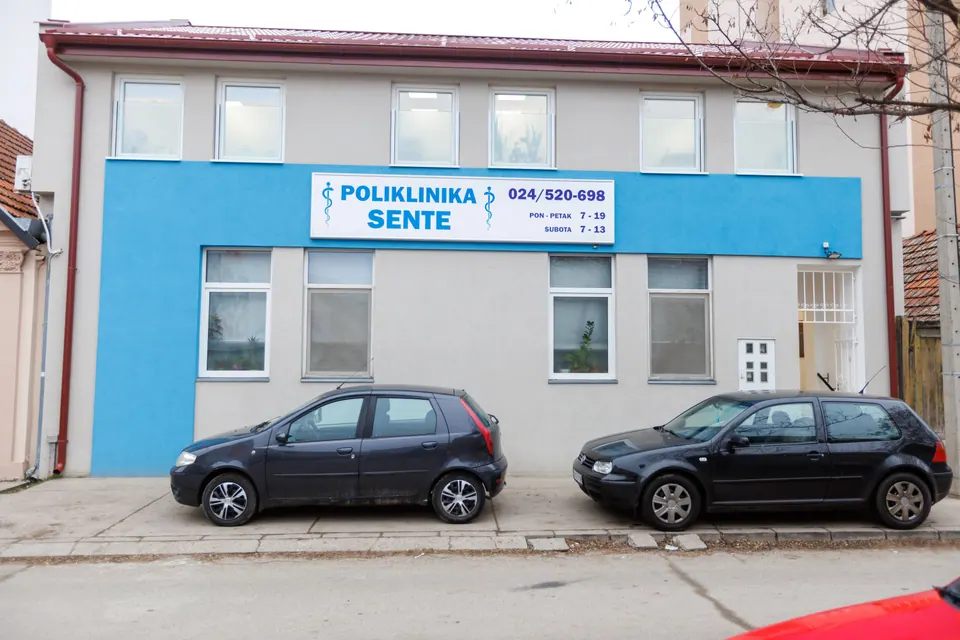 Poliklinika Sente, Lajoša Joa 4A, Subotica
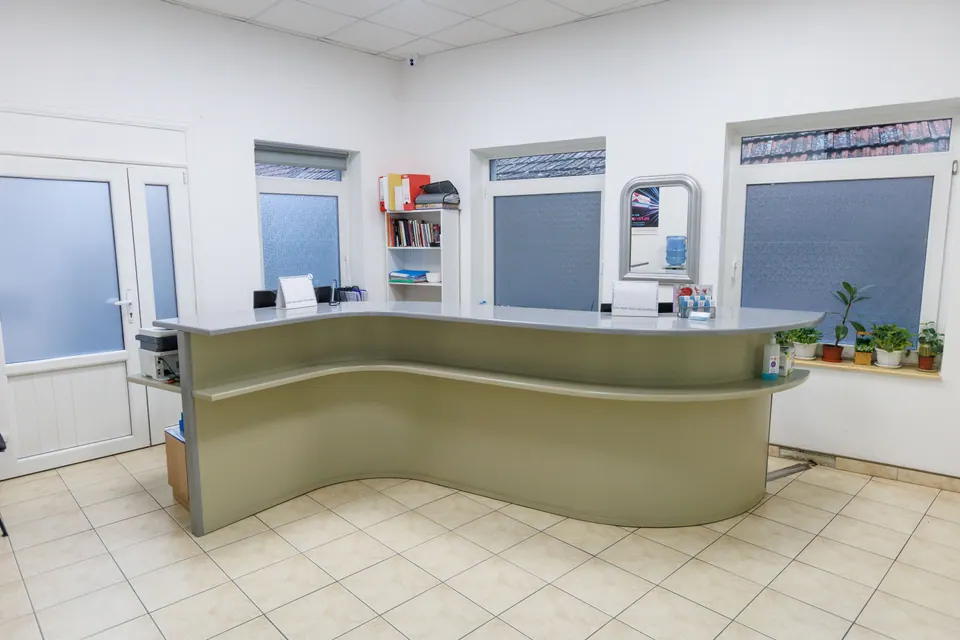 Reception and patient registration
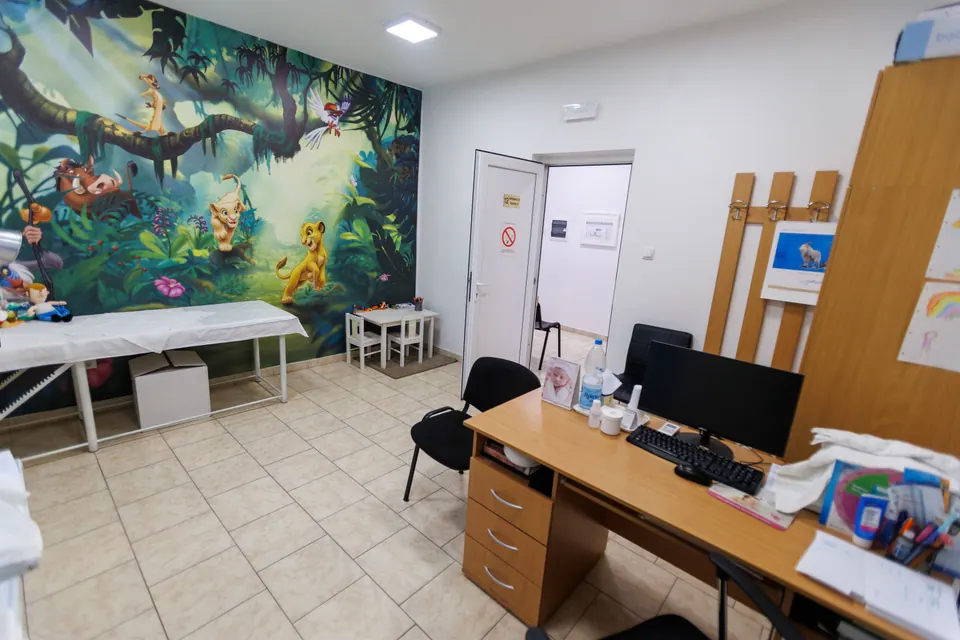 Room for our youngest patients
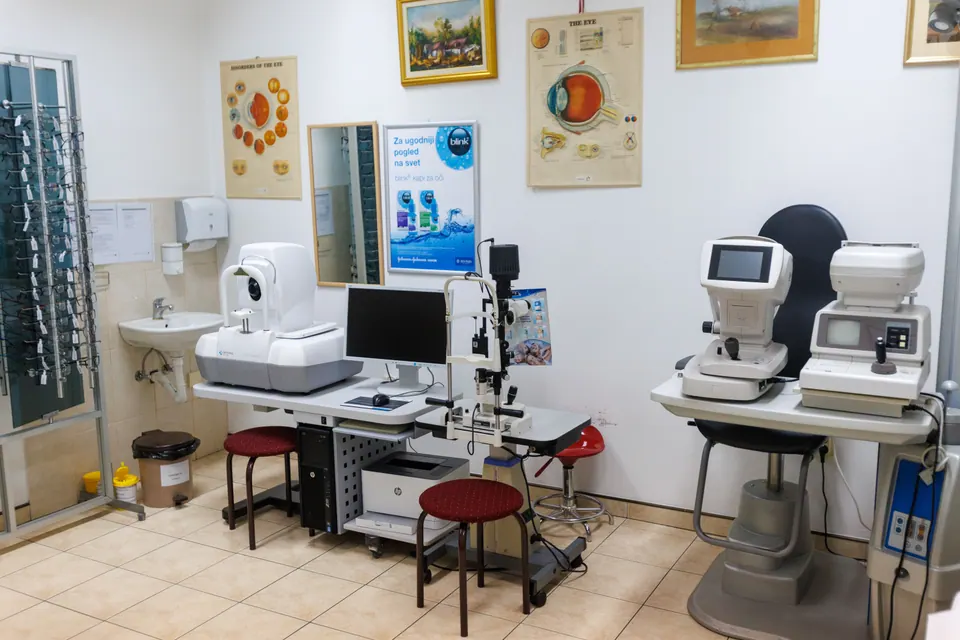 Eye clinic room
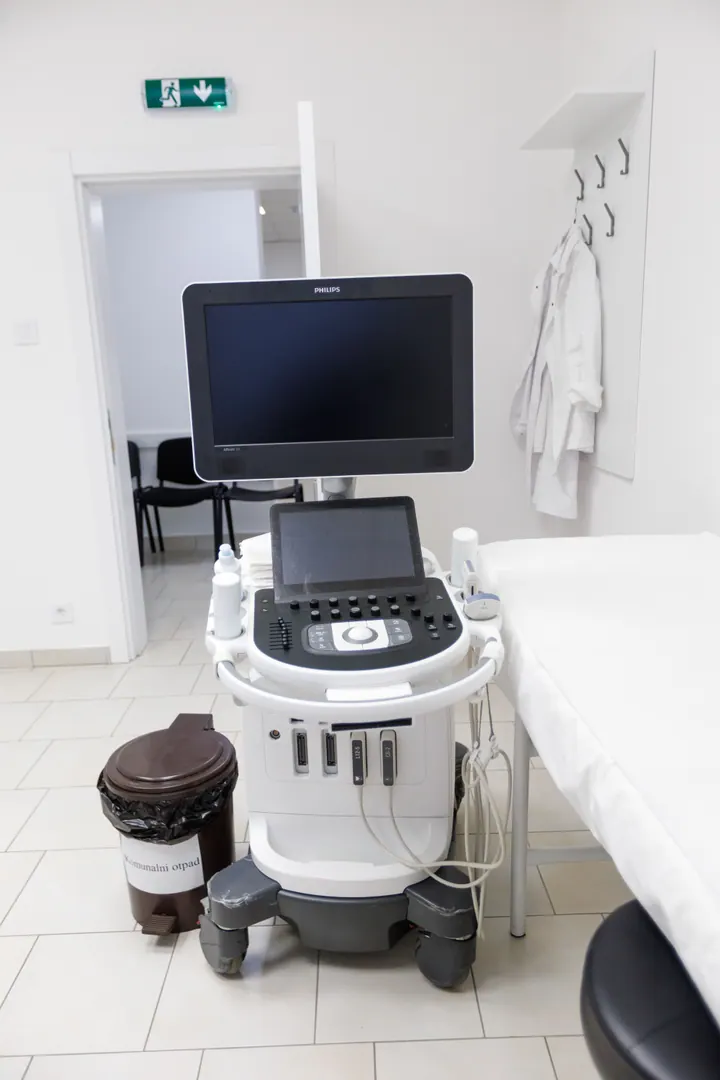 Ultrasound machine
For your convenience we book appointments in advance, by phone or in person. Call the landline or the mobile number, we answer both throughout our opening hours.