
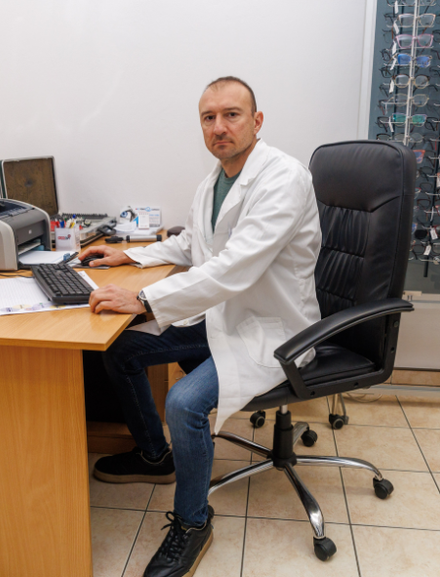
dr med Boris Karadžić
Ophthalmologist
Complete eye examination, refraction, diseases of the anterior and posterior segment of the eye in adults and children, eyelid and cataract surgery.
Prices and available appointments: 024 520 698 and 066 52 32 899
An ophthalmologist deals with vision and diseases of the eye and its accessory organs, the eyelids and the tear system.
Many eye diseases, such as glaucoma and retinal changes in diabetes, cause no symptoms for a long time. They are found only by an examination, which is why eyes should be checked even when you see well.
At Poliklinika Sente ophthalmologists examine adults and children: they determine refraction, measure eye pressure, examine the fundus and treat diseases of the anterior and posterior segment of the eye.
The Polyclinic's ophthalmologists also work in eyelid and cataract surgery. Ask about the options and appointments when you book.
When you book, say which doctor you would like to see. If there is no free appointment with that doctor, reception will offer you the nearest available slot.
Ophthalmologist
Ophthalmologist
The articles in this section serve to educate and inform visitors to this website. They are not medical advice and cannot replace an examination by a doctor.
A missing part of the picture, a shadow to one side or passing blurring can come from the eye, but also from the blood vessels and the brain. That is why these symptoms are not left for later.
The visual field is everything we see while looking straight ahead, including the periphery. When a gap appears in it, the brain often fills it in with the surrounding image, so the patient does not see a black patch but notices that things are slipping past them: catching a door frame, not seeing a car coming from the side, losing their line while reading.
The cause may lie in the eye itself. Glaucoma damages the visual field gradually and from the periphery, for a long time without any pain. Diseases of the retina, its detachment or changes in the macula produce their own characteristic gaps, along with distortion of straight lines or a dark curtain that spreads.
Some symptoms, however, do not come from the eye at all. The visual pathway runs from the eye to the occipital lobe of the brain, so damage anywhere along that path produces a gap in the visual field. When the gap affects the same half of the visual field in both eyes, the origin is as a rule behind the eye. A passing loss of vision in one eye, lasting minutes and resolving on its own, may be a sign of disturbed blood supply and is treated as a warning event, in the same way as passing weakness of an arm or a disturbance of speech.
This is why an eye examination in these situations does not stop at testing visual acuity. The fundus is examined, eye pressure is measured and, where indicated, the visual field is tested, and the findings are considered together with blood pressure, blood sugar, blood lipids and neurological status.
A practical rule: a suddenly appearing gap, a shadow, flashes of light, a sudden increase in floaters or a passing loss of vision are emergencies and are not left until next week. A gradual change, noticed by chance, also calls for an examination, only not on the same day.
Author: dr med Boris Karadžić
In diabetes, changes in the retina develop before vision gets worse. That is why the fundus is examined by the calendar, not by how you feel.
Diabetic retinopathy is damage to the small blood vessels of the retina caused by long-standing raised blood sugar. Its defining feature is that in the early stages it produces no symptoms. Vision is normal, the patient has neither pain nor blurring, yet changes in the fundus are already present and can be seen on examination.
When vision does get worse, it usually means that the change has reached the central part of the retina or that bleeding has occurred. At that point treatment is still possible, but the aim becomes preserving what remains rather than preventing the damage from happening.
For this reason a fundus examination is not requested because of symptoms but as a matter of routine. In type 2 diabetes the examination is carried out as soon as the diagnosis is made, because the disease often goes unrecognised for years before it is found. The interval between further check-ups is set according to the findings, the duration of the disease, blood sugar values, blood pressure and blood lipids, and in pregnancy the check-ups are more frequent.
The same applies to other conditions that affect the blood vessels. Raised blood pressure leaves its trace on the fundus, and that finding is useful to the internist as well, because it shows the state of the small blood vessels at the only place in the body where they can be seen directly.
In practice, if you have diabetes or raised blood pressure, a fundus examination is part of routine follow-up, just as much as laboratory tests are. The findings will be normal many times over, and that is precisely the point.
Author: dr med Boris Karadžić
Adults without symptoms are advised to have a check every few years, and more often after forty, because of glaucoma. People with diabetes or high blood pressure have regular fundus examinations, at intervals set by the doctor.
Appointments are booked by phone, on 024 520 698 or 066 52 32 899, Monday to Friday from 07:30 to 20:00 and on Saturday from 08:00 to 13:00. Poliklinika Sente is at Lajoša Joa 4A, in the centre of Subotica.
Information on prices and available appointments is provided by the Poliklinika Sente call centre, on 024 520 698 and 066 52 32 899.
Yes. Poliklinika Sente works with private insurance companies. Check what your policy covers with your insurer or when you book.
Appointments are booked by phone. Monday to Friday from 07:30 to 20:00, Saturday from 08:00 to 13:00. Prices and available appointments are given on the same numbers.