
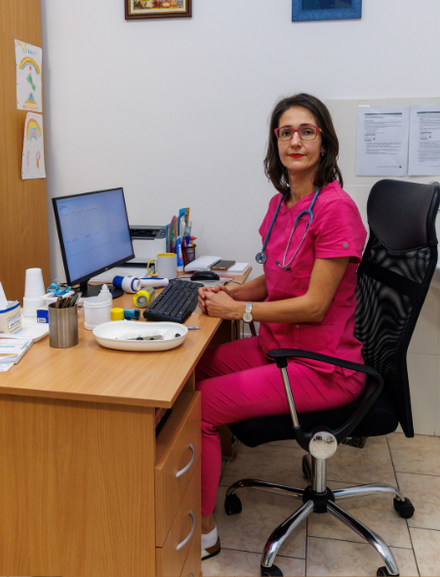
dr Tijana Torbica Bukvić
Paediatrician and pulmonologist
Paediatric examinations, growth and development monitoring, health checks for children, ultrasound in babies, paediatric pulmonology and allergology.
Prices and available appointments: 024 520 698 and 066 52 32 899
A paediatrician looks after a child's health from birth to adolescence: growth and development, acute illness and chronic conditions.
A good paediatric examination answers not only whether the child is ill, but also whether the child is developing as expected. Many difficulties with sight, hearing, speech or posture are easiest to solve when found early.
At Poliklinika Sente paediatricians examine and treat childhood illnesses, carry out preventive and routine health checks for children and perform ultrasound in babies and children: hips, central nervous system, abdomen, neck and thyroid, and soft tissues.
For children with asthma, allergies and frequent respiratory illness a paediatric pulmonologist and a paediatric allergist are available, with spirometry and skin prick allergy testing, and a developmental neuropsychiatrist for developmental difficulties.
When you book, say which doctor you would like to see. If there is no free appointment with that doctor, reception will offer you the nearest available slot.
Paediatrician and pulmonologist
Paediatrician

Paediatrician
Paediatrician, immunologist and allergist
Paediatrician, developmental neuropsychiatrist and clinical geneticist
Examinations carried out at Poliklinika Sente, with a description of what they involve and how to prepare.
Spirometry is a test of the function of the lungs and airways. It measures how much air the lungs can hold and how fast air moves through the airways.
What it involves and how to prepare →Otoacoustic emissions are a very faint sound produced by the inner ear in response to sound. Measuring them checks hearing objectively, from the very first days of life.
What it involves and how to prepare →Ultrasound shows organs and tissues in real time, without radiation and without pain. It is completely safe, so the examination can be repeated as often as necessary.
What it involves and how to prepare →The articles in this section serve to educate and inform visitors to this website. They are not medical advice and cannot replace an examination by a doctor.
Vision, hearing, posture and speech. What goes unnoticed in nursery can show up at school as a learning difficulty or as a behavioural problem.
Starting school is the moment when a child first spends a long stretch of time on a task that demands looking both close up and into the distance, listening in a noisy room and sitting in the same position. For that reason conditions that had until then passed unnoticed are found at this age more often than earlier.
Vision comes first on the list. A child who sees poorly will rarely say so, because they have nothing to compare it with. Instead, you notice the exercise book being held close, squinting, headaches after school and attention fading quickly during reading. A squint, a difference between the eyes and uncompensated long-sightedness call for an eye examination, not for waiting to see whether the child will grow out of it.
Hearing comes second. Reduced hearing in a child does not look like reduced hearing, it looks like inattention, slower speech development, turning up the television or asking for things to be repeated. Repeated ear infections and fluid that persists in the middle ear are the most common cause that can be put right, and that is reason enough to have hearing measured rather than judged by impression.
Alongside this go an assessment of posture and the spine, of speech and pronunciation, and a basic general check-up covering growth, body weight and vaccination status. If the child has a chronic illness, an allergy or ongoing therapy, this is also the moment to bring the plan into line with the school day.
The point is not to look for a problem at any cost, but for the child to enter the first year without an obstacle that is easy to remove and that is later easily misread as a lack of motivation.
During the first months at nursery or school a child can go through one infection after another. Here is what a usual course looks like, and what departs from it and calls for an examination.
Starting nursery or school is regularly followed by a period of frequent respiratory infections. To parents this seems alarming, particularly when the child barely recovers before falling ill again. Medically, in the great majority of cases this is an expected process: the child meets a large number of viruses in a group setting for the first time, and the immune system builds a response to each of them separately.
Six to twelve respiratory infections a year, during the first two years in a group setting, need not mean that anything is wrong with the immune system. A typical viral infection lasts from a few days to a week, with a temperature in the first days, a runny nose and a cough that can linger after the other symptoms have settled. Between episodes the child recovers, eats, plays and returns to their usual self.
There are, however, signs that call for an examination rather than waiting. These are a temperature that lasts longer than three days or returns after a fever-free period, laboured or rapid breathing, drawing in of the spaces between the ribs, marked listlessness and refusal of fluids, earache, a cough lasting more than three weeks, and any infection in an infant. Repeated infections that require an antibiotic every time also deserve assessment.
What genuinely helps is less spectacular than people expect: proper sleep, regular meals, time outdoors, hand hygiene and, importantly, keeping the child at home while they have a temperature. Immune-boosting preparations are no substitute for this and are not given routinely.
The aim of an examination during this period is not to treat every cold, but to separate the usual course from what departs from it, and to recognise an ear infection, pneumonia or airway obstruction in time.
Spirometry can be done from the age of five, when the child is able to cooperate. At Poliklinika Sente it is done for children by a paediatrician and pulmonologist, with bronchodilator and bronchoprovocation testing.
Appointments are booked by phone, on 024 520 698 or 066 52 32 899, Monday to Friday from 07:30 to 20:00 and on Saturday from 08:00 to 13:00. Poliklinika Sente is at Lajoša Joa 4A, in the centre of Subotica.
Information on prices and available appointments is provided by the Poliklinika Sente call centre, on 024 520 698 and 066 52 32 899.
Yes. Poliklinika Sente works with private insurance companies. Check what your policy covers with your insurer or when you book.
Appointments are booked by phone. Monday to Friday from 07:30 to 20:00, Saturday from 08:00 to 13:00. Prices and available appointments are given on the same numbers.