
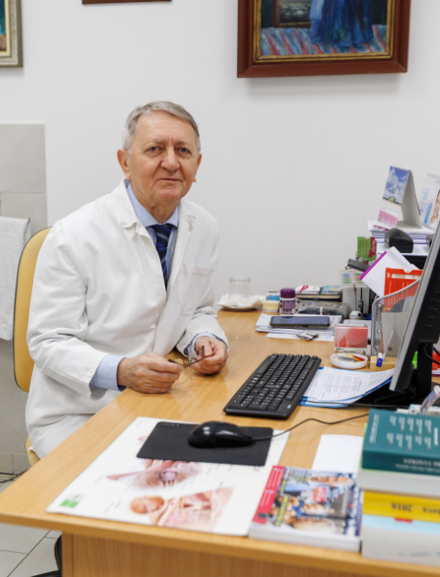
Prim dr med Marko Sente
ENT specialist and audiologist
Ear, nose and throat conditions, hearing tests for babies and adults, balance testing, videoendoscopy and endoscopic sinus surgery.
Prices and available appointments: 024 520 698 and 066 52 32 899
An otorhinolaryngologist (ENT specialist) deals with diseases of the ear, nose, sinuses, pharynx and larynx, as well as hearing and balance. ENT goes hand in hand with audiology: hearing assessment and the treatment and rehabilitation of hearing loss.
Many ENT problems seem harmless, such as a blocked nose, snoring or slightly reduced hearing, yet they affect sleep, concentration, speech development in children and general health.
At Poliklinika Sente hearing tests for babies, children and adults (audiometry, tympanometry, otoacoustic emissions and BERA), balance testing (videonystagmography and vHIT), nasal videoendoscopy, videolaryngoscopy and sleep polygraphy are all available in one place.
The Polyclinic's ENT specialists also perform nasal septum, sinus and polyp surgery, functional endoscopic sinus surgery (FESS) and correction of protruding ears.
When you book, say which doctor you would like to see. If there is no free appointment with that doctor, reception will offer you the nearest available slot.
ENT specialist and audiologist
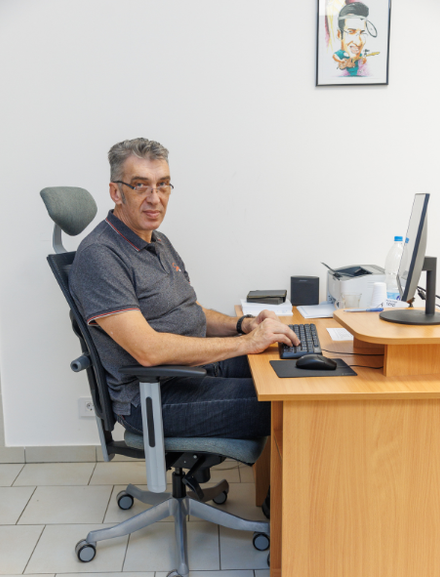
ENT specialist
ENT specialist
Resident in otorhinolaryngology
Examinations carried out at Poliklinika Sente, with a description of what they involve and how to prepare.
Audiometry is a test that determines the hearing threshold: the quietest tone a person can still hear, at each frequency and in each ear separately.
What it involves and how to prepare →Tympanometry is a measurement that checks the middle ear: the mobility of the eardrum and the ossicles, the condition of the middle ear cavity and the patency of the Eustachian tube.
What it involves and how to prepare →Otoacoustic emissions are a very faint sound produced by the inner ear in response to sound. Measuring them checks hearing objectively, from the very first days of life.
What it involves and how to prepare →BERA is an objective hearing test that measures the electrical response of the auditory pathway to sound. It needs no cooperation from the patient, so the hearing threshold can be determined even in a baby.
What it involves and how to prepare →Videonystagmography is a computerised test of the sense of balance. Infrared cameras built into special goggles record eye movements and so show how the balance organ in the inner ear is working.
What it involves and how to prepare →The video head impulse test (vHIT) is an objective test of the balance organ in the inner ear. It shows how each of the six semicircular canals works individually.
What it involves and how to prepare →Nasal video endoscopy is an examination of the nasal cavity, the sinus openings and the upper part of the throat with a thin endoscope fitted with a camera. It takes two to five minutes and shows what a standard ENT examination cannot.
What it involves and how to prepare →Video laryngoscopy is an examination of the larynx, vocal cords and throat with a flexible instrument fitted with a camera. It is done on an outpatient basis, takes a few minutes and is not painful.
What it involves and how to prepare →A sleep study (polygraphy) investigates snoring and pauses in breathing during sleep (sleep apnoea). It is done at home, in your own bed, with a device that monitors your breathing through the night.
What it involves and how to prepare →FESS, functional endoscopic sinus surgery, is a minimally invasive operation that restores normal ventilation and drainage of the sinuses. It is performed through the nose, with no external incisions.
What it involves and how to prepare →BERA (Brainstem Evoked Response Audiometry) is an audiological examination that records the electrical response of the auditory nerve and the brainstem to sound signals. Unlike conventional pure-tone audiometry, the patient does not have to press a button or say whether they heard a tone: the response is measured objectively, through electrodes, regardless of age or ability to cooperate.
The examination is painless and non-invasive. Small surface electrodes are placed on the skin of the forehead and behind the ears, and short sound signals are played through earphones. Meanwhile the patient lies still, relaxed or asleep, while the device records a series of waves. Their shape, their timing and the quietest signal at which they still appear show what level sound reaches and whether it travels normally along the hearing pathway.
BERA is most often performed in babies and young children whose hearing screening was not passed or in whom hearing loss is suspected, and in children with delayed speech development. In adults it helps assess hearing loss that affects one ear or both ears unequally, ringing in one ear and dizziness, because it distinguishes damage to the inner ear from changes along the auditory nerve and guides further diagnostics. It is also used when the result of conventional audiometry is not reliable.
The examination is performed by Prim dr med Marko Sente, ENT specialist and audiologist. BERA is performed by appointment,usually on the recommendation of an ENT specialist. Hair should be clean, without gel or cream, and young children manage the examination most easily while asleep, so it helps if the child arrives sleepy. We will explain all the details of preparation when you book.
The articles in this section serve to educate and inform visitors to this website. They are not medical advice and cannot replace an examination by a doctor.
Tonsils have a role of their own, so they are not removed because they are large. The decision rests on the number and severity of infections, and on how the child breathes and sleeps.
The tonsils are part of the lymphatic tissue of the throat and have a function of their own in early childhood. The size of the tonsils is therefore not in itself a reason for surgery. Enlarged tonsils in a child are a common and often temporary finding.
The first question is whether the infection is viral or bacterial. Most sore throats in children are viral and are treated symptomatically, without antibiotics. Streptococcal tonsillitis is treated with an antibiotic, and here it matters that the course is completed in full rather than stopped when the symptoms ease. The clinical picture and, where needed, a throat swab or a rapid test are used to tell them apart.
The second question is frequency. Removal of the tonsils is considered when infections are repeated and documented over a longer period, when they are accompanied by high fever and absence from school, when complications such as an abscess have occurred, or when there is a rheumatic or kidney complication in the background. The number of episodes and their severity, recorded over time, count for more than an impression.
The third question is breathing. In some children the problem is not infection but obstruction: the child snores, breathes through the mouth, sleeps restlessly, wakes up tired and has pauses in breathing during sleep. The adenoids are often involved as well. This group of symptoms is today the most common reason for surgery, because disturbed breathing during sleep affects growth, behaviour and attention.
The decision is therefore made on the basis of the history and the examination, and not on the basis of one severe infection. The aim of an ENT examination is to separate the child who needs follow-up from the child for whom surgery genuinely solves the problem.
The first sign of hearing loss is usually not silence, but difficulty understanding speech when there is background noise. A view from the audiologist's side.
Patients rarely arrive saying that they hear poorly. Far more often they say that they can hear someone speaking but cannot make out what is being said, particularly in company, in a restaurant or when the television is on. The reason is that hearing loss usually appears first at the high frequencies, and it is precisely those that carry the consonants which tell words apart. The vowels, which are lower, remain loud, so speech sounds present but unclear.
Turning up the volume therefore does not solve the problem. Louder speech in noise remains just as indistinct, and the people around the patient notice that the television is getting louder before the patient notices that they are not hearing.
Audiological testing exists so that this can be measured rather than estimated. Pure-tone audiometry establishes the hearing threshold by frequency and for each ear, tympanometry checks the state of the middle ear and the mobility of the eardrum, and speech audiometry shows what actually troubles the patient: how many words they understand at a given volume. The findings separate conductive hearing loss, which can often be treated, from sensorineural loss, which is rehabilitated.
Delay has a price. Hearing that goes unused makes the understanding of speech worse over time, because the brain loses its practice in processing sound. Along with this goes withdrawal from conversation and company, which is easily put down to character rather than to hearing.
There are also situations that will not wait: sudden loss of hearing in one ear, hearing loss accompanied by dizziness, ringing in one ear only, and hearing that has changed abruptly after an injury or an infection. In those cases the examination is arranged immediately.
In babies hearing is tested with methods that need no cooperation: otoacoustic emissions (OAE) and, when a more precise test is needed, BERA. Both are painless and are done at Poliklinika Sente.
Appointments are booked by phone, on 024 520 698 or 066 52 32 899, Monday to Friday from 07:30 to 20:00 and on Saturday from 08:00 to 13:00. Poliklinika Sente is at Lajoša Joa 4A, in the centre of Subotica.
Information on prices and available appointments is provided by the Poliklinika Sente call centre, on 024 520 698 and 066 52 32 899.
Yes. Poliklinika Sente works with private insurance companies. Check what your policy covers with your insurer or when you book.
Appointments are booked by phone. Monday to Friday from 07:30 to 20:00, Saturday from 08:00 to 13:00. Prices and available appointments are given on the same numbers.